Sexual Describes Male or Female, Right?

children painting

When Christians use the phrases “sexual from birth” or “sexual beings,” we’re simply describing our maleness or femaleness, aren’t we?

This is likely how many sincere Christians understand it.  Remember, however, that male or female describes the kind of human we are.  You may never have heard it explained this way before, so it bears repeating.  Male or female has more than a sexual connotation; it is our divinely appointed vocation.  It is a way to engage life.  The vocations of male and female are God-given roles rooted in God’s creation of each individual human, as opposed to the kinds of vocations that men and women choose or take up later in life (such as father, mother, teacher, or pastor).  Those who oppose God don’t care about this because, like Kinsey, they have no respect for male or female.  God does.  So, let’s consider this in light of His Word.

God did not make male and female at the same time, in the same way or for the same purpose (Gn. 2:7, 15, 18-22).  Their differences did not conflict, but were complementary.  As husband and wife, Adam and Eve were lovers, that is, they were sexually intimate.  The human race came from their procreative sexual union; Eve because the “mother of all the living” (Gn. 3:20).  But, not every complementary man or woman marries and thus, becomes a lover or sexually active.

There is sexual love and there is agape love.  Husbands and wives share sexual intimacy, but all males and females of any age can share (and practice) agape love.  Scripture says it is the “will of God, your sanctification,” that you abstain from sexual immorality; that each one of you know how to control his [or her] own boy in holiness and honor, not in the passion of lust like [those] who do not know God” (1 Thes. 4:3-5).  Scripture is clear.  The sexual part of us is designed for use within the parameters of marriage.

To be lovers or, in other words, to share sexual intimacy and literally fit together in the procreational act of sex, is reserved for marriage between one man and one woman.  To be male or female, however, is a design and vocation for daily use in glorifying God.  God does not tell us to abstain from being male or female.  God does not tell us to abstain from being the human beings He created us to be, but He does tell us to abstain from sexual activity except within marriage.  Sexual activity is not an intrinsic part of what it means to be human.  We don’t do battle with the attributes of maleness or femaleness, but with “sexual immorality, impurity, sensuality, idolatry . . . [T]hose who belong to Christ Jesus have crucified the flesh with its passions and desires” (Gal. 5:19-24).  Unmarried males and females, of any age, are not to be lovers, but they are free to practice agape love which is this:

Love is patient and kind; love does not envy or boast; it is not arrogant or rude.  It does not insist on its own way; it is not irritable or resentful; it does not rejoice at wrongdoing, but rejoices with the truth.  Love bears all things, believes all things, hopes all things, endures all things (1 Co. 13:4-).

From The Failure of Sex Education in the Church:
Mistaken Identity, Compromised Purity (pp. 94-95)
by Linda Bartlett (Amazon)


Sexuality is Central to Being Human, Right?

backs of children

It is true, isn’t it, that sexuality is a central part of being human?

That’s what SIECUS (Sexuality Information and Education Council of the U.S.) says.  One of their core values is that “sexuality is a central part of being human.”  But what does God say?  Does He say that sexuality (understood as sexual desires and the ability to be sexually intimate) is a central part of being human?  If so, where does He say that?  And what does this  mean, specifically when speaking about children?

Animals and humans bear similarity in the fact that both continue their species sexually, not asexually like amoebas.  But should we be defined by the way we procreate?  Central to being human is our distinction from animals.  It is having the attributes of God.  Unlike animals, humans have the ability to reason; to be kind, faithful, patient, and just.  We derive knowledge of God’s will for creation.  In our vocations a male and female humans, we have opportunity to make use of our humanness in different yet compatible ways with glory to God.  Even in the Garden of Eden, God did not clothe Adam and Eve with sexuality or sensuality.  He clothed them with His glory.  If sexuality is central to being human (as defined by Kinsey and company), what happens when we can’t or don’t express sexual desires and needs?  Are we less human?  The present culture seems to demand sexual rights.  But is sexuality a right from God or a privilege and responsibility within the boundaries of marriage?

It would be cruel, don’t you think, if God were to identify even children as “sexual beings” but then tell us we cannot freely be the very thing He created us to be?  God wants us to be what He created us to be: holy people who live our daily lives as male and female not just in marriage, but in familial and social relationships, in school, at work, and in worship.  He created us to be relational people but, because He did not make sexuality central to being human, we can relate to one another in non-sexual ways.  We can be in all kinds of selfless relationships– parents and children, brothers and sisters, caring neighbors, co-workers–that draw attention to Jesus Christ.  Jesus Christ was fully human, but only in error would we identify Him as a “sexual being.”

Sin warped the image of God that we humans were created to bear.  But the moment a person trusts Christ, he or she begins to receive a new nature (2 Cor. 5:17).  Baptized, we are saints–or holy ones–set apart for God through the death and resurrection of Jesus.  Holiness–whether it is reckoned to us freely (justification) or begins to characterize us (sanctification), whether we are receiving it as a free gift or cooperating with God to bring it about within us–is central to being human.  We are “debtors, not to the flesh, to live according to the flesh” (Ro. 8:12), but to Christ in whom the fallen nature has no claim on us.

We might want to say, “I am a sexual being.  I can’t help being who I am!”  But in Christ, we are not obligated to obey impulses of the flesh or satisfy its desires.  Why?  Because Christians are sanctified.  Sanctification is the process by which God develops our new nature, enabling us to grow into more holiness (not sexiness) through time.  This is a continuous process with many victories and defeats as the new nature battles with the “old man” (Ro. 6:6) in which it presently resides.  In heaven, the new nature will be set free, not as a sexual being (understood as sexually active), but as a holy being in the perfectly restored image of God.

From The Failure of Sex Education in the Church:
Mistaken Identity, Compromised Purity, pp. 92-93
by Linda Bartlett (Amaz0n)


Not Identified by Our Stomachs

eating

Aren’t we making too much out of this sexual identity thing?  After all, humans are sexual and we do need sex, right?

Well, we have stomachs and appetites, too.  Some have even claimed, “You are what you eat.”  But, observes  my friend Bob Morrison,

No one considers himself an alimentary being.  Food– nourishment–is essential to human life.  It’s natural.  But if we focus on that as the essence of our being, then, as St. Paul writes, our “god is in our belly” (Phil. 3:19).  Sex within marriage is right, but we should not forget that this gift is given so that the human race might continue and generations may know Christ.”

C.S. Lewis agrees with my friend Bob and with St. Paul.  He writes,

There is nothing to be ashamed of in enjoying your food: there would be everything to be ashamed of if half the world made food the main interest of their lives and spent their time looking at pictures of food and dribbling and smacking their lips.”  (Mere Christianity)

from The Failure of Sex Education in the Church:
Mistaken Identity, Compromised Purity
by Linda Bartlett (Amazon)

Identity Affects Behavior

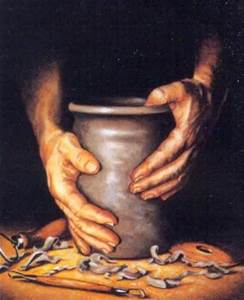
potter's hands verticalThere is an inevitable result of identifying myself as a “sexual being.”  Such thinking will affect the way I fear, love and trust God. It will affect the way I act in His presence and understand His purpose for my life. It will also tempt me to see God in a way He is not.

As a fallen creature, I have a troublesome habit of projecting onto the Creator God my idea of Him based upon how I see myself. If I see myself as His daughter in Christ, I will be more inclined to recognize Him for who He is and acknowledge His authority. But if I see myself as “sexual being,” then I will be more inclined to define God according to my human perspective and on my human terms and less inclined to acknowledge His authority. This corrupts the image of God. Why? Because God does not bear the image of man nor is He sexual or sensual. God is holy.

God mandates holiness and He reveals its source. It is nothing other than Himself, His very essence and character. God is holy and expects me to conform to Him. “As obedient children, do not be conformed to the passions of your former ignorance, but as he who called you is holy, you also be holy in all your conduct, since it is written, ‘You shall be holy, for I am holy’” (1 Pet. 1:14-16).

It is not absolutely necessary that I experience the joy of “one flesh” in biblical marriage, but it is absolutely necessary that I should be holy. That which is sexual should never be viewed as a way to become more intimate with God nor should it become the intrinsic identity of the male and female first made in the image of God. In my Baptism, I put on the “new self” which is “the likeness of God in true righteousness and holiness” (Eph. 4:24).

Identity affects my behavior. Let’s imagine that I am pregnant but contemplating an abortion. I need to ask, “What is it? What is this that I want to abort?” Women have explained to me that when the doctor called their unborn child a “blob of tissue,” it made the wrong thing that they knew they were doing much easier to do.  If I identify myself as a “sexual being” and my child as a “choice,” then I may fail to guard the treasure for which Jesus died.  I may fall into fear, then into idolatry.  It is then that I will find arguments for abortion, adultery, homosexuality and the counterfeiting or abolition of marriage.

The mistaken identity of “sexual from birth” tempts me to please myself. God did not have this in mind, so He does not identify me in this way because that phrase confuses my created femaleness with the corrupted state of my current sexual desires. A “sexual” identity is all about “me.” It means being in debt to my own flesh and bound to live according to its fickle ways. But a “holy” identity is all about God claiming me as His dear child in Christ. In Christ, my fallen nature has no claim on me. My flesh side may tempt me, saying, “This is who I am,” or “I owe it to myself,” but I am not obligated to obey its impulses or satisfy its desires. Why? Because I “did not receive the spirit of slavery to fall back into fear” (Rom. 8:15). What a difference this makes in the way I live and who I worship.

In the biblical context, holy usually means “set apart for God”. It means being different from the sensual world. I am “His own possession” (1 Pet. 2:9). As a “temple of God,” I have no agreement with idols (2 Cor. 6:16). This means no foolish or improper talk of sexual desire, no crude joking or teasing of the imagination. My purpose in this world flows from my identity as God’s holy one. My purpose is to “proclaim the excellencies of Him who called me” (1 Pet. 2:9). My behavior, just like my identity, is not common. Something that is common is useable by anyone. But I am useable by God. My conduct as a baptized child of God— indeed, “holy one” or saint— should not reflect the ways of the sinful world, but reflect God’s ways.

I am called to be “a vessel for honorable use, set apart as holy, useful to the master of the house, ready for every good work” (2 Tim. 2:21). God is the master. The house is my body. My good work is to turn the heads of others toward the master and away from myself. “[B]e holy in all your conduct” (1 Pet. 1:15). Why? Because I was created for God’s glory, not my own. I am to “walk as [a child] of light . . . and try to discern what is pleasing to the Lord” (Eph. 5:8-10).

Adapted from
The Failure of Sex Education in the Church:
Mistaken Identity, Compromised Purity
by Linda Bartlett, Amazon

Identity: Now and Forever

wedding feastIf I am fundamentally “sexual,” then this would hold true not just before my promised resurrection but also after my resurrection. (Otherwise after my resurrection, I would be less than human.)

But what does Jesus say? “For in the resurrection they neither marry nor are given in marriage, but are like angels in heaven” (Matt. 22:30). Therefore being sexual, that is, capable of sexual activity, is not part of what it means to be human after the resurrection. And if it is not part of my divinely-created human identity in the resurrection where everything will be made perfect, then it is not the central part of my divinely-created identity now.

In heaven, there will be no marriage.  Men and women will not “desire” one another nor will they unite in “one flesh.”

So, will I lose my identity in heaven? No! My true identity will remain intact. I will be as He created me—fully human, but perfect in every way; a daughter at her Father’s table. I will still be His treasure in Christ but, at last, able to truly reflect His magnificence.

For now, I live on earth in human flesh. I do not have to obey the passions of my mortal body (Ro. 6:12) however, because holiness is all about God claiming me as His dear child in Christ through water and Word. Through Baptism, I am in relationship with all of my siblings—brothers and sisters in Christ who can anticipate His return. With the help of the Holy Spirit, I can encourage and care for my brothers and sisters in ways that will not bring shame on the Day of the Lord (1 Jn. 2:28).

Adapted from
The Failure of Sex Education in the Church:
Mistaken Identity, Compromised Purity
by Linda Bartlett (Amazon)

Identity: Inseparable from Sexuality?

robe of righteousness

That’s what Christopher Yuan thought.

As a young man, Christopher struggled with homosexual desires. He prayed that God would change him. When God did not, Christopher gave up the struggle, believing, “This is who I am.” While serving time in prison for drug-dealing, Christopher confessed his sexual identity to a chaplain who told him that Scripture doesn’t condemn homosexuality. Christopher was motivated to contrast the information given to him by the chaplain with God’s Word of Scripture. In light of the Word, Christopher realized that “my identity shouldn’t be defined by my sexuality.”

Christopher writes,

Paul said in Acts 17:28, “For in him we live and move and have our being.” Christ should be everything—my all in all. My sexual orientation didn’t have to be the core of who I was. My primary identity didn’t have to be defined by my feelings or sexual attractions. My identity was not “gay” or “homosexual,” or even “heterosexual,” for that matter. But my identity as a child of the living God must be in Jesus Christ alone.
God says, “Be holy, for I am holy.” I had always thought that the opposite of homosexuality was heterosexuality. But actually the opposite of homosexuality is holiness. God never said, “Be heterosexual, for I am heterosexual.” He said, “Be holy, for I am holy.”

Christopher desired change. But, he writes, “change is not the absence of struggles; change is the freedom to choose holiness in the midst of our struggles.”

In The Book of Man, Bill Bennett tells about his friend who was recovering from life-threatening cancer. “His doctor told him that he could not work, exercise, or enjoy the other fruits of life,” explains Bennett, “all things that men pride themselves on. I asked him what hurts the most to be without. ‘Work,’ he said. ‘I don’t feel like a man. Work has more to do with me being a man than sex or muscle.’”

Excerpted from
The Failure of Sex Education in the Church:
Mistaken Identity, Compromised Purity
by Linda Bartlett (Amazon)

Who Does God Say That I Am?

woman shaped by PotterGod alone has the right to bestow my identity because “It is he who has made [me] and [I am] his” (Ps. 100:3). I am His creation (Gen. 1:27). All people were created in God’s image, not the image of animals. God is holy, not sexual, sensual, or captive to instincts. God says, “You shall be holy, for I am holy” (1 Pet. 1:16).

But the Fall into sin introduced horrible corruption to the human race, so that now the thoughts and desires of people are sinful and centered on serving the self (Gen. 6:5; Eph. 2:3). Christians, however, have been given the Holy Spirit who begins in them a “new creation” (2 Cor. 5:17; Gal. 6:15), and starts to re-form the image of God in them (Col. 3:10). All of us struggle with our sinful human nature because we are sons of Adam and daughters of Eve, but we are not bound to that human nature because of the washing and renewal of our Baptism (Tit. 3:5-8). In my Baptism, Jesus Christ restored my identity as an “heir” of eternal life. I am strengthened to “abstain from the passions of the flesh, which wage war against [my] soul” (1 Pet. 2:11). Re-creation in Christ makes me God’s adopted child who is invited to cry “Abba! Father!” (Rom. 8:15).

My body is “a temple of the Holy Spirit” bought at great price (1 Cor. 6:19). I am a treasure of God for whom Jesus gave all He had. In Christ crucified, I reclaim my identity. Since Jesus is holy, God declares me holy through faith in Him. “I have called you by name,” God says. “You are mine” (Isa. 43:1). “‘I will be a father to you, and you shall be sons and daughters to me,’ says the Lord Almighty” (2 Cor. 6:18). Jesus spoke to my full person and human identity when He said, “You shall love the Lord your God with all your heart and with all your soul and with all your mind and with all your strength” (Mk. 12:30).

I hold to a body-soul anthropology or understanding of the origin, nature and destiny of mankind as expressed in the Athanasian Creed. I believe I will be resurrected, not as a disembodied spirit, but with a perfect body joined with a perfect soul. In heaven, I will not be an angel but my resurrected body will be like that of angels (Matt. 22:30). I will neither marry nor be given in marriage. This is a sound argument against the idea that human beings are fundamentally “sexual”. If that were true, in the resurrection I would be somehow less than human.

Adapted from
The Failure of Sex Education in the Church:
Mistaken Identity, Compromised Purity
by Linda Bartlett (Amazon)

If I’m So Normal, Why Am I So Unhappy?

unhappy girlThe young women who find their way to the Lighthouse, a pregnancy and parenting resource center in my home town, might seem familiar to you. Actually, they could be your neighbor’s daughter, your pastor’s daughter or your daughter. They are not “bad” girls; rather, they are “normal” girls.

A negative pregnancy test provides opportunity to talk about their “normal” lives. One young woman, with goals of finishing high school and going on to college, opened the door to that conversation with a heartfelt confession. “I don’t understand. I’m not any different from my Facebook friends. I’m not any different from the people on TV. I dress like the models in my favorite magazines and do the things everyone else says they are doing. But if I’m so normal, why am I so unhappy?”

As a campus psychiatrist at UCLA, Dr. Miriam Grossman spent a lot of time with “normal” but “unhappy” young women. These educated women with goals of med school, performing arts or corporate law had little in life to complain about. They had active social lives, enough money and caring families. “Life is good,” they would tell Dr. Grossman, “so why do I feel so depressed? So emotionally stressed? So worthless?”

“If I’m so normal, why am I so unhappy?” This question—asked in small town pregnancy centers and on Ivy League campuses—should tug at the heart and soul of every pro-life parent, grandparent and pastor. “No amount of Prozac or Zoloft,” writes Dr. Grossman, “is going to solve this problem. These young women must, for their physical and emotional well-being, change their lifestyle.”

Change their lifestyle? But aren’t young women today more liberated than ever before? Haven’t the barriers that prevented complete happiness been chipped away? Isn’t it true that women can compete with men in sports, the workplace and the bedroom? It’s true, but all the supposed liberation in the world only puts us in conflict with ourselves.

In Genesis 1: 27, we learn that God created humans to be male and female. Later, and with more detail (Genesis 2), we learn that God created male and female at different times, in different ways and for different purposes. Try to ignore it if you will but a woman is built to bear and nurture children.

Matters of a woman’s heart are influenced by her biological design. Yes, my feminist friends, I said biological design. “The blurring of differences between male and female,” writes Dr. Grossman, “is a radical agenda unsupported by hard science.” One of the failures of nearly every kind of sex education, including Christianized sex education, is that we lump boys and girls together as equally “sexual beings” who just need more information and more comfort with their sexuality. But Dr. Marianne Legato, founder and director of the Partnership for Gender Specific Medicine at Columbia University, sees women’s health as more than a political or feminist issue because women differ from men in every system of their body.

It would seem that this important piece of biblical and scientific truth has been withheld from the young women who carry the burdens of depression, disease, fear, and broken hearts in the door of the Lighthouse and every other pregnancy center across this country.

Matters of a woman’s heart, by design, are connected to the love of one man, home and family. At the Lighthouse, however, we see young women who’ve been disconnected from all that is naturally womanly—most especially anything related to motherhood and childbearing—as something to be managed, minimized or even overcome. They have been shot up with Gardacil and soon after, like a right of passage, ceremoniously prescribed the Pill. They are prodded onto the football field, wrestling mat and arena of combat—no “holds barred”—which puts them at odds with their own biological and psychological functions and renders them more vulnerable. In abstinence class, they are reminded over and over again that sex is the most wondrous of all earthly gifts but not to be opened until marriage after first getting their degree, securing a good job and paying off loans. However, next to their heart is a biological clock that “tick, tick, ticks” the years of fertility away.

Girls have been told that they are no less sexual than any boy and have every right to enjoy the pleasantries of intimacy. But most girls have not been told about oxytocin, the neurochemical that floods a woman’s brain during a cuddle or a kiss. By design, oxytocin promotes trust and serves to bond a woman to the man she is with. Oxytocin at work in a wife who is sexually intimate with her husband helps produce long-term connectedness which is good for children.

But bonding is like glue. It can’t be undone or ripped apart without great emotional pain. Once, I asked a young woman why she was spending nights with her boyfriend. She responded, “Well I was hoping that if I did, he would ask me to marry him.” During another visit, she told me how much she liked tending “their” garden and decorating “their” house. “But,” I asked, “when it’s the end of the day and you sleep over, whose bed do you sleep in? Do you think of it as his… or ‘ours’”? Her eyes dropped. Her shoulders slumped. She whispered, “It’s his.”

A great many young women, despite the cultural acceptance of multiple partners, want to be married to one man and make a nest for their children. But a woman’s consent to play house without commitment of marriage actually encourages many young men to postpone marriage.

“I’m just doing what everyone else is doing. I’m normal.” So then why is this girl so depressed and unhappy? Because it is simply abnormal for a woman to be in conflict with the design of her own body. “Thus says the Lord, your Redeemer, who formed you from the womb: I am the Lord, who made all things, who alone stretched out the heavens, who spread out the earth by myself, who frustrates the signs of liars . . . who turns wise men back and makes their knowledge foolish” (Isaiah 44:24-25).

At the Lighthouse, we take matters of the heart very seriously. We want to guard the physical and spiritual health of a young woman just as we want to guard her right to a childhood, right to girlhood, and right to maidenhood.

This was first written as an article for LifeDate (LFL).
Linda Bartlett is co-founder/president of the Lighthouse Center of Hope
and author of The Failure of Sex Education in the Church:
Mistaken Identity, Compromised Purity

(Amazon – Our Identity Matters)
Miriam Grossman, M.D., is the author of Unprotected (Amazon).

Stop Sexualizing Children, Ruffle Feathers

Jesus and little children

Three decades of questions led to the writing of a book I did not want to write.

  • Why do even Christian women choose abortion?
  • Why do Christian girls and women dress as provocatively as non-Christians?
  • Why do so many Christians live together outside of marriage?
  • Why do a growing number of Christians defend homosexuality and counterfeit marriage?
  • Why are children sexualized beginning at young ages?

The book, says Dr. Daniel Heimbach, will “ruffle feathers.”

Daniel R. Heimbach, Ph.D., is the senior professor of Christian Ethics at Southeastern Baptist Theological Seminary in Wake Forest, NC.  He is also a Research Fellow in Christian Ethics with the Ethics & Religious Liberty Commission.  Dr. Heimbach has authored True Sexual Morality: Recovering Biblical Standards for a Culture in Crisis and Why Not Same-Sex Marriage: A Manual for Defending Marriage Against Radical Deconstruction.

Dr. Heimbach recently reviewed The Failure of Sex Education in the Church: Mistaken Identity, Compromised Purity (Amazon).  He writes:

This book exposes what has been driving the sexual education movement in Western culture in recent decades.  Bartlett speaks truth that will ruffle feathers because she exposes lies on which the PC movement operates.  Although she writes with conviction Bartlett is not contentious, meaning only to stop parents, churches, and schools from harming children in the guise of educating them.  This book may even startle some very conservative Christians, but what Bartlett argues is convincing.  Sex education cannot be redeemed and needs to be rejected entirely because the whole movement is established to forward notions fundamentally contrary to biblical reality.  We are never more free than when restraining the flesh on God’s terms and never more enslaved than when seeking to follow and express our own fleshly desires without restraint.

Dr. Heimbach and his ministry associates Russell Moore and Albert Mohler are faithful to examine the biblical standards on sexual morality.  They recognize the counterfeit views that have crept into our “sexually revolutionized” society.  Heimbach offers wise analysis of a deep and pervasive problem as a pastor, theologian, and professor.  His books, notes Albert Mohler, “frame debate and encourage Christians to battle for moral sanity and for souls.”  I am not a pastor, theologian, or professor.  My book is written from the perspective of a wife, mom, grandmother, pro-life advocate, and woman who has listened to countless stories of men, women and children who suffer the consequences of a mistaken identity.

I don’t want to ruffle feathers.  I am, at heart, a peacemaker.  But there comes a time when even a peacemaker has to rise up in the face of evil.  This is that time.  It is not because I want to, but because I am compelled to… for the sake of my grandchildren.

To learn more about the book, please visit:
Our Identity Matters or Amazon

Unhooked and Set Free (Part 2)

two women walking on beachMaura, my young friend, has bonded with her boyfriend.  She doesn’t seem to want to be with anyone else.  In fact, she moved in with him with the hope that he will ask her to marry him.

It’s really quite remarkable, don’t you think?  Despite the cultural acceptance of multiple partners most young women want to be married to one man and make a nest for their children.  Unfortunately, a woman’s consent to play house outside the commitment of marriage actually encourages young men to postpone marriage.

So what is going on with Maura?  Why has she bonded with her boyfriend?  I believe it’s because faith and science are at work in Maura’s life.  The Creator of life has not only written Himself on Maura but also wired her for monogamous attachment.

Right now, Maura’s faith is relegated to Sunday morning or an occasional religious discussion with her dad or me.  But, I’d like to help Maura see that faith intersects with daily life in all areas including the physical, emotional, and relational.  Together, Maura and I are learning that God has designed a woman’s body and mind to connect through the biological wonder of neurochemicals.

Oxytocin, or the “cuddle” hormone,” is a neurochemical.  It is present in both male and female, but is primarily active in females.  The female body releases oxytocin at four different times.  Take note!  Each has to do with procreation and the care of children.  Oxytocin is released:

  • During meaningful or intimate touching with another person (Action: bonding and trust)
  • During sexual intercourse (Action: bonding and trust)
  • During the onset of labor in a pregnant woman (Action: causes uterine contractions, results in birth)
  • After baby’s delivery (Action: stimulates nipples and produces flow of milk from mom for nursing)

Oxytocin, which floods a woman’s brain during labor, childbirth and breast-feeding, creates a bond between mother and child.  But first, it creates a bond between the parents of that child.  When a man and a woman touch in familiar and intimate ways, oxytocin is released into the woman’s brain.  Without being able to explain why, she desires more of that same kind of intimacy.  Can you see how oxytocin plays a vital role in the “one flesh” union of one man and one woman in marriage?  Oxytocin helps assure the continuation of the human race!

Oxytocin bonding helps produce long-term connectedness. It might be for this reason that an American woman in an intact marriage rarely has sexual intercourse with anyone but her husband.  Such stability is affected by oxytocin.  Think of the significance.  The bonding of father and mother greatly increases the chance for a child to be raised in a healthy, two-parent home.  Such a child is blessed not necessarily with perfect parents but with a mom and dad who mentor faithfulness.

The world speaks about the emotions of love.  The emotions of connectedness.  In reality, the desire to connect is more than an emotional feeling.  Bonding is like glue.  And it can’t be undone or ripped apart without great emotional pain.

The flow of oxytocin serves to promote trust.  Oxytocin triggered the bonding process between Maura and her boyfriend even before they went “all the way” but only kissed and hugged.  Do parents know this?  Do moms who think it’s “cute” that their 12-year-old daughter has a “boyfriend” and dads who allow 14-year-old daughters to spend long periods of time alone with a boy realize that they are placing vulnerable girls at risk?  A girl’s protective boundary of modesty and inhibition gradually breaks down with each kiss, each touch, each pledge of love… even though the boy she’s with has no intention of marrying her or having children with her.

Maura confessed,  “It’s so very strange.  The more time I spend with my boyfriend, the more I need to be with him.”  Maura’s neurochemicals are doing what they were designed to do.

Here, then, is one of the failures of sex education.  Children are imagined as “sexual from birth.”  The wonders of sex and sexuality are dangled like carrots in front of them from early age through high school and beyond.  Then hands are washed when the educators say, “We told them to wait.”  But can anyone turn off the oxytocin?

Maura and I are talking about the glue of oxytocin.  I hope she is telling her friend Nichole.  Nichole has been in several intimate relationships.  She has “hooked up.”  She has “friends with benefits.”  It all seems so casual and harmless.  But, oxytocin is at work.  Every time that Nichole and her “friend” break up and she moves on to a new sexual partner, a bond is broken.  This is emotional.  Painful.  Sometimes paralyzing.

Being sexually intimate with one person, breaking up, and being sexually intimate with another is like a divorce.  Repeating this cycle again and again places a girl in danger of negative emotional consequences.  Sexual activity creates emotional bonds between partners.  Breaking these bonds can damage the brain’s natural connecting or bonding mechanism, cause depression, and even make it more difficult to bond in marriage.  Nichole doesn’t realize it, but her choices are in conflict with her own body and the way she was designed to function.

Sexual intimacy, as Maura has discovered, is addictive.  But through the honesty of a friend, she is learning why her body, mind and soul are so interconnected.  It is by Divine Design.  As her friend, I can’t force a change in her behavior but I can be a reminder of why God’s design for marriage matters.

If Nichole is your friend, too, will you speak up?  Will you tell her about the “glue” of oxytocin?  Will you help her unhook… and be set free to better navigate away from depression and hardness of heart?  Will you tell her how well her body has been woven together and why and by Whom?

This was first posted by Ezerwoman with appreciation to
Joe S. McIlhaney, Jr., M.D., and Freda McKissic Bush, M.D., authors of
Hooked: New Science on How Casual Sex is Affecting our Children.